News of Seasonal Produce Offerings, Auctions, Events, Agritourism and Farmers in Casey County, Kentucky ~ and the Old Order Mennonite & Amish Communities ~ located in the scenic Knobs Region and agricultural heart of Kentucky.
Showing posts with label Buy Local. Show all posts

Friday, June 20, 2014

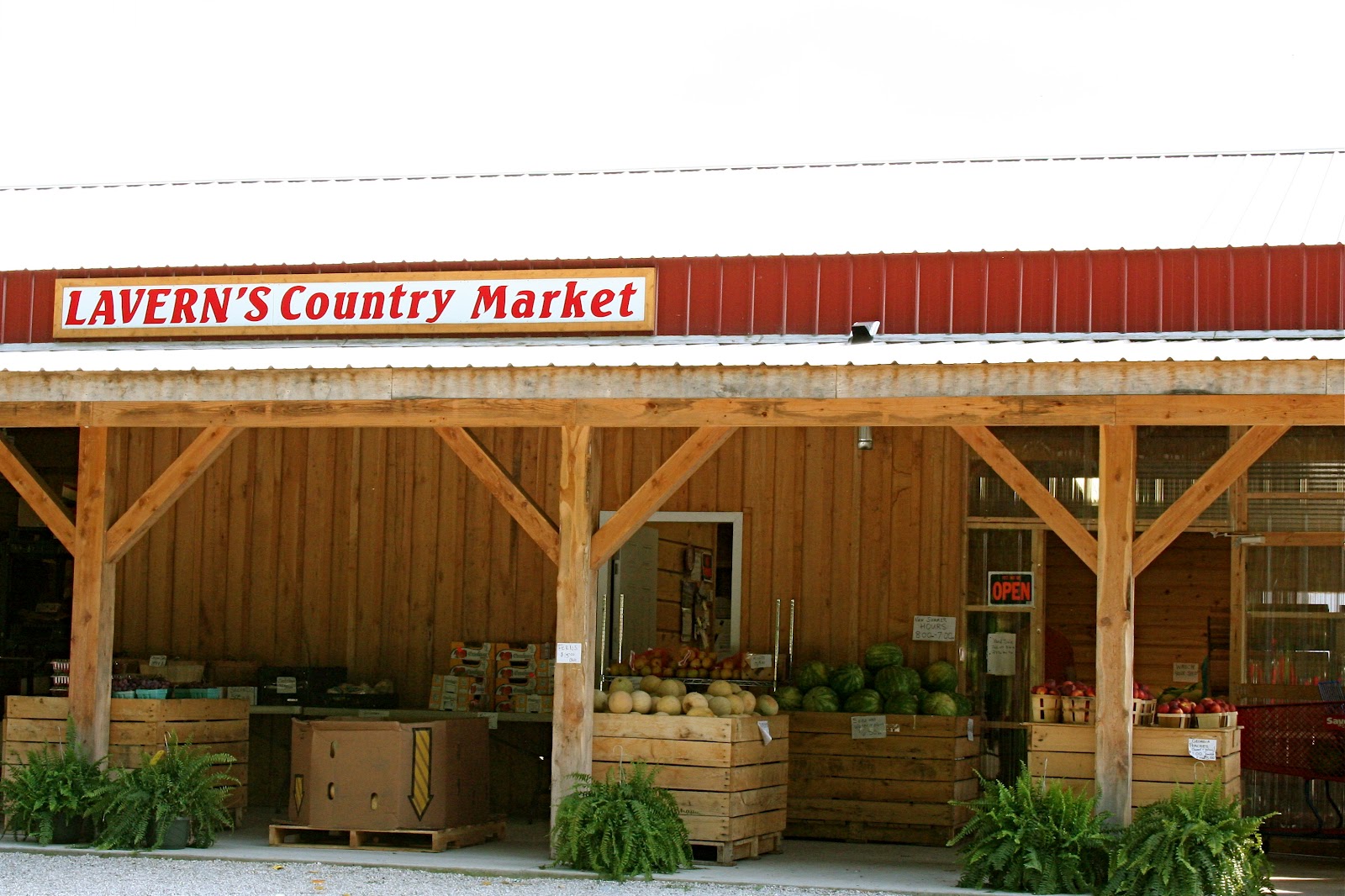
Fresh Local Produce at Lavern's Country Market


Today I went to Lavern's Country Market to get a watermelon––just a watermelon, mind you. I knew it wouldn't be local yet (but soon!), however Georgia is close enough when you are craving a nice piece of cold, sweet melon. Then I saw the large Georgia cantaloupes: had to have one of those, too (even though Casey County will soon be full of them). Then when I went inside I thought I should grab a cart. Well, a few minutes later I had quite a haul. Most of it was affordable, LOCAL produce and much of that was not only affordable but also organically grown. The rest was grown in the deeper South (not sure about the bananas or celery but American, at least). The best part is that I didn't have sticker shock at the register. My total? $37.00 for everything you see in the photograph above!

Here's the LOCAL breakdown:

  • 6 organic summer squash 
    • ($1 for 6)
  • 3 organic zucchini 
    • ($1 for 3)
  • 2 large bags organic lettuce 
    • ($2 each)
  • 2 large bags of beets 
    • ($2 each)
  • 3 hot-house tomatoes ($2 each)
  • 1 pint organic raspberries ($2.50)
  • 1 pint blueberries ($2.50)


Here's the breakdown for the rest (grown in the US):

  • 1 medium-sized seedless watermelon (Georgia)
  • 1 large cantaloupe (Georgia)
  • 2 large bags carrots ($2 each)
  • 1 bunch celery
  • 1 large bag Vidalia onions
  • 2 bunches of bananas


Who says you can't eat both healthy and affordably, and right here in Casey County? Here there is no need to pay a high premium for locally-grown organic produce or to drive to Danville or Lexington to find it. [Of note is that the organic-local or local summer squash and zukes were the very same price.] Word is out, too, as the parking lot was packed. Best produce in the county, I'd say (well, except for your own or your favorite neighboring farmer...or what you mind find at the Casey County Produce Auction).

Lavern's also sells a variety of cheeses, locally-raised eggs, jams, jellies, nuts, cookbooks, and plants. They will soon be expanding their offerings to more natural foods, too. They are open year-round with a changing offering of local produce, and other produce from further afield, and specialize in year-round hot house tomatoes grown here in Casey County.

WHERE: Lavern's Country Market
At the corner of Hwy 910 and South Fork Creek Road
in central Casey County, Kentucky
OPEN: Monday-Saturday: 8am-6pm (sometimes later)
INFO: Lavern Zimmerman, Proprietor
Call (606) 787-9845 for more information or for wholesale inquiries.

Tuesday, June 17, 2014

Casey County Produce Auction In Full Swing

Some early heirloom tomatoes.
The Casey County Produce Auction is now held every Monday, Wednesday and Friday at 4pm on South Fork Creek in Casey County. Click here for a link to their 2014 schedule.

NOTE: Friday's auctions tend to be the busiest right now, with the most amount of offerings. What that generally means for the buyer is that you can get some real deals much of the time on Monday and Wednesday. The auction is a great place to come if you want small or larger batches for canning, freezing or eating fresh: or if you need larger lots to sell retail somewhere else. Sometimes you can even buy or swap partial lots with someone else: for example, a friend bought a lot of three bushels of Georgia peaches yesterday, each for $6, and she sold me one. At the very least, you can enjoy the auction and have a bite to eat, or an ice cream cone, at the chuck wagon.


Here are some highlights from yesterday's auction (the photographs below are all of locally grown produce in Casey County and surrounding areas):


You can always bid on smaller lots on the produce tables.

Saturday, June 7, 2014

OPEN HOUSE: MeadowBrook Orchards & Farm


On Saturday, June 28th from 1-5pm, the public is warmly invited to an open house at MeadowBrook Orchards and Farm in western Casey County, half-way between Campbellsville and Liberty, Kentucky and not far from Hwy 70 [scroll down to see map].

Diana Paluy and Bruce Gruber have been farming in Casey County for the past six years. You can read more about them and their farm offerings in a previous post on this blog by clicking here.

You can also "Friend" them on Facebook where Diana posts regular musings of farm life, updates on what's available or where/when they might be selling and even recipes. 

One of several newly planted vegetable gardens.
They will have an abundance of heirloom tomatoes and other vegetables in the months ahead. In a few years they plan to have heirloom apples and other fruits available to the public.

An heirloom variety of salvia.

In the meantime, come tour their extensive vegetable, herb and flower gardens and set a spell on the porch! Just scroll beneath the recent photos from their emergent garden for more information and a map to their farm.


Johnny Jump-Ups galore!

Hosta & Nepeta ("Catmint")
The Conservatory


The farm's pack of friendly, loving farm dogs might greet you.

DATE & TIME: 
Saturday, June 28th, 1-5pm

LOCATION: 
680 Dug Hill Road, Elk Horn, KY 

PHONE: (606) 787-4690


View Larger Map
MeadowBrook gardens in high summer.

Wednesday, September 4, 2013

Wendell Berry on Empowering the Local Economy


I am trying to revive this blog and Facebook page after there have been significant changes (with many Mennonite businesses now gone and several Amish farmers moving in) and other new additions to the Casey County agricultural scene. I'm still posting remotely and with a failed camera lens at present, too, so bear with me! I'm hoping by spring of 2013 to have things up and running in a more regular capacity. In the meantime I will blog on occasion as to agricultural-related topics.

As far as I'm concerned, and I know I'm not alone, Wendell Berry is a national treasure and that is he a native Kentucky writer, poet, philosopher and farmer makes him all the more endearing. If you've ever read Berry's essays you realize that he has been consistently ahead of his time in terms of the local food movement, sustainable agriculture, and our political economy. He is also largely an unsung hero because he is so humble and unassertive––his words wield the power if you care to read them.

And it is odd that I was reading his work today. When I went to find an image on the Internet to put in this blog post, I discovered it was just announced that he will receive the overall Freedom Award from the Franklin D. Roosevelt Four Freedoms Awards for community and personal responsibility on October 16th in New York City.

Here is an extended passage from his essay "Farming and the Global Economy" which appeared in his collection Another Turn of the Crank [Washington, DC: Counterpoint, 1995]:
"If a safe, sustainable local food economy appeals to some of us as a goal that we would like to work for, then we must be careful to recognize not only the great power of the interests arrayed against us but also our own weakness. The hope for such a food economy as we desire is represented by no politcial party and is spoken for by no national public officials of any consequence. Our national political leaders do not know what we are talking about, and they are without the local affections and allegiances that would permit them to learn what we are talking about.
But we should also understand that our predicament is not without precedent; it is approximately the same as that of the proponents of the Stamp Act––and with one difference in our favor: in order to do the work that we must do, we do not need a national organization. What we must do is simple: we must shorten the distance that our food is transported so that we are eating more and more from local supplies, more and more to the benefit of local farmers, and more and more to the satisfaction of local consumers. This can be done by cooperation among small organizations: conservation groups, churches, neighborhood associations, consumer co-oops, local merchants, local independent banks, and organizations of small farmers. It can also be done by cooperation between individuals and consumers. We should not be discouraged to find that local food economies can grow only gradually; it is better that they should grow gradually. But as they grow they will bring about a significant return of power, wealth, and health to the people.
One thing at least should be obvious to us all: the whole human population of the world cannot live on imported food. Some people somewhere are going to have to grow the food. And wherever food is grown the growing of it will raise the same two questions: How do you preserve the land in use? And how do you preserve the people who use the land?
The farther the food is transported, the harder it will be to answer those questions correctly. The correct answers will not come as the inevitable by-products of the aims, policies, and procedures of international trade, free or unfree. They cannot be legislated or imposed by international or national or state agencies. They can only be supplied locally, by skilled and highly motivated local farmers meeting as directly as possible the needs of informed local consumers."

Sunday, June 10, 2012

Ambling Along South Fork Creek

A familiar sight in Casey County, Kentucky!
Yesterday on my way home from an excellent two-day writing conference in Lexington, I realized we needed (or is that wanted?) blueberries. And peaches. And lettuce. I could have bought stuff at Good Foods Coop (where they sell a great deal of seasonal Casey County produce) or gone down Hwy-27 to Somerset and hit Kroger. But I decided to detour instead through Casey County and go 'the back way' to our farm here in Pulaski County. Since our boys are out of school for the summer, and because we've been so busy on our own farm, we've not been over there as much as we'd like in the past month. As usual, I was not disappointed.


At Lavern's I found some local romaine lettuce and some affordable mushrooms (not local). There, while examining the last of their recent shipment of peaches (I got some luscious Georgia peaches there a few days back), I met a friendly older couple from Marion County who said they shop at the Mennonite markets all the time. [And they, like us, like to try them all out for various offerings.]

'Oh you don't want those peaches,' they said, 'You need to go up to the market on the hill where they are dead ripe.'

Never having heard that expression before, I asked if that was a bad thing. 'Oh no, they make the best jam, if that's what you want.'

Well, that's what I wanted: to make peach jam. I thanked them and headed to Hillside Greenhouse and Produce next where I saw the couple again, only this time lugging out a big box of Georgia peaches. [NOTE: they also have local blueberries now! Get them while they are here.]

'I hope you left some for me,' I joked. 'What are you planning to make with them?'

'Peach butter,' they smiled while echoing the lovely phrase of 'peach' and 'butter' paired in unison. I thought that sounded like a plan, too, when jam was done. As well as cobbler and fruit salad and more sangria or just eating them out of the box. Oh, so many things. The great thing about our local fresh produce, whether local or from a nearby state in season, is that you can practically live on it for half the year. Peach season is long here because, in August, several area produce markets sell a variety of peaches from Pennsylvania (that we find are well-suited to canning). As the local growing season hasn't even begun to hit full stride here in Casey County, there are still many months ahead to enjoy everything including squash, tomatoes, peppers, cucumber, corn and melons! And because of the advanced growing season after a warm winter and spring, everything is ready earlier this year.

Local 'maters are in! Some greenhouse, some field grown, but 100% local.

I realized something else. Every time I am 'down in the valley' as we say, referring to where many of the Mennonite farms and businesses are located along South Fork Creek, I see cars from so many Kentucky counties: Marion, Boyle, Fayette, Pulaski, Russell, Adair and yes, even Casey. There are Ohio cars. Indiana cars. Cars from Tennessee. Cars that are from most any where but here. Next time you go inside Sunny Valley Country Store, make sure to check out the large map with push pins from all over the country marking where visitors live.

Casey County's produce and other Old Order Mennonite offerings have long been a kind of 'destination tourism' and it is encouraging to see that continuing, despite the economy and the rising price of gas. Saturdays are generally the busiest day of the week but on any given day you are apt to see day-trippers and tourists from further afield. Paul Hoover said that the Casey County Produce Auction has also seen an increase in visitors and buyers this year.

Hillside Produce (on hill in background) set up a special fruit stand
for the Casey County Bank ATM open house on Saturday.

A while back the Casey County Bank put in an ATM machine down in the valley. At first it seemed incongruous, like a pop machine might seem, placed as it was on the porch of the Old Order Mennonite-operated Sunny Valley Country Store. But it has proven to be quite handy, especially for those day-tripping tourists that local businesses like to see, and for the Mennonite businesses who need to make deposits (and it saves them from driving their horses and buggies into town to do their banking). It is important to say that this bank has been locally owned and operated since its beginnings (despite various economic crashes, slumps and disasters)––and is a true 'Main Street' bank in every sense of the word. It has never been swallowed up by larger banks and how rare and amazing is that in today's corporate world? They certainly have our business and admiration.

Yesterday the bank hosted an open house there to encourage people to come and learn about the new state-of-the-art ATM (according to bank president Mark Wolford, it is the first ATM of its kind in Kentucky and is capable of all sorts of transactions). While I'm not certain, I suspect one reason the bank wanted to host the open house was to also educate the Old Order Mennonites in how to use an ATM. This culture, while well-preserved and protected, now flirts with modernity, too.

Paul Hoover cuts into a melon to share with his son, Keith.
By the way, those are local blueberries: get them while available!

South Fork Creek Road now has another offering and the only place to catch a bite to eat along the way: The Wagon Trail, located just east of the Casey County Produce Auction, now serving hamburgers, pulled BBQ sandwiches, flame-broiled pork burgers, shakes, sundaes, homemade pie, cold cut sandwiches and other tasty things to eat or drink. Stop by while you're out-and-about and visit with the Sizemore family who are running it adjacent to their home. [Or Friend them on Facebook by clicking on the above link.]

Hours of operation [all are located on South Fork Creek]:

Casey County Bank ATM: 24/7!
Hillside Produce & Greenhouse: Monday-Saturday, 9am-5pm
Lavern's Country Store: Monday-Saturday, 9am-7pm
The Wagon Trail: Monday-Saturday, 11am-7pm

Thursday, May 24, 2012

PROFILE: MeadowBrook Orchards & Farm

Bruce Gruber and Diana Paluy on their renovated farmer porch
at MeadowBrook Orchards and Farm in western Casey County.
It's not every day that someone can reclaim an old farm and make it their own––retrofitting a derelict farmhouse and clearing the landscape into once again useable acreage. In only a few years, former Georgians Diana Paluy and Bruce Gruber have revitalized the old house and landscape at their MeadowBrook Orchards and Farm in western Casey County. They have transformed its waterways and have established a working farmstead complete with several ponds, hayfields, a dam, a large growing orchard and many gardens. 

Prior to their back-to-the-land odyssey, Bruce once played minor league baseball and still works as a disaster housing inspector. Meanwhile, Diana was a vice-president at a contracting company and has lived all over the world––now infusing her excellent cooking with the varied culinary aspects of her travels. Like many who have moved to the region they have a ready answer to this question: 'How did you find Casey County?' The answer involves having just under a day's drive to Atlanta (where they still have family and friends), the picturesque rolling hills and open farmland of Casey County that are a reminder of Bruce's native Connecticut, and, of importance to any farmer: good and affordable land.


Soon after they moved here in 2008, house modifications and brush-clearing took first priority. Within two years the house was renovated and expanded to Bruce's design, allowing a wrap-around porch for shade from the southern sun, regular entertaining––and seedlings, of course. There is also a handy attached greenhouse in the southeast corner, with future plans to build a larger separate one.

Diana is a natural green thumb and brought many of her roses from Georgia and the couple is now growing apples, a variety of fruits, tomatoes, and vegetables––everything is an 'heirloom,' or antique variety: 'like Bruce,' she jokes. This year, MeadowBrook Orchards and Farm has an extensive offering of heirloom tomato seedlings, and other plants, all started from seed saved by Diana. Heirloom plants––certain varieties of which many Casey Countians have always grown––are true to seed and have better flavor, color and other qualities that make them unique and highly sought after by chefs and foodies and anyone who appreciates them. As heirlooms are not grown for shipping (or long-term storage, as are many hybrids), it is becoming easier to find them in local farm markets. And, perhaps best of all, you can save the seed (if it is grown in a protected place away from other like plants).


'The irony in all this is that I don't even like raw tomatoes...or peppers. How I've evolved into primarily a tomato-pepper 'farmer' is a mystery,' Diana said. Yet she grows, harvests and cans them like a fiend, despite herself, while admitting that the added lycopene to their diets has only benefited the couple. Meanwhile, Bruce has devised a tomato stake-trellis system used by many veteran 'mater planters in the county and taught to him by a local farmer. The couple puts out several hundred tomato plants and have started offering extra seedlings for sale and will be selling various produce, also, when in season.

Casey County, as well as a few other rural areas of Kentucky where farmland is both affordable and arable, is seeing a resurgence in sustenance farming among locals and newcomers, alike. Certain farmers are embracing the 'niche farming' market and farm or raise specific crops or livestock in smaller, more manageable practices and for specific markets. They're hanging out their farm signs and finding ways to market their crops in new ways on the Internet, at local venues like Marksbury Farm, regional farmer's markets or collaboratively (such as at the Casey County Produce Auction, organized by the Mennonite community but available to all who wish to sell or buy there). [NOTE: a group is actively forming to work on collaborative farm marketing for the county/region––more information soon!]

There are many loving, and well-loved, dogs to greet you at MeadowBrook.

In the next few weeks, Diana and Bruce may be at upcoming Casey County Produce Auctions (for 2012 schedule and information, click here) with some flats of tomato seedlings or you can call and/or stop by at their farm to choose and purchase plants (and later produce). They would welcome the opportunity to sell to anyone who would appreciate these delicious varieties and are currently offering the following tomato plants (with limited basil, pepper and other options):

Anna Russian, Aunt Ruby's German Green, Black PlumBlack Zebra, Bloody Butcher (an early 60 day tomato), Cherokee PurpleChocolate Stripes, Costaluto FlorentinoJubilee, Pineapple, Pink Brandywine, Principe Borghese (a plum variety that Italians use for sun-drying), San Marzano (a Roma type), White Tomesol, and, Diana's Black Globe (her own variety brought up from Georgia). [There are also two indeterminate beefsteak varieties available: a pink-red and an orange-pink.]

MeadowBrook Orchards and Farm
680 Dug Hill Road
Elk Horn, KY 42733
606-787-4690

Open: Monday-Saturday, 9am-6pm
Email: Diana.dughillrd@msn.com


Despite its Elk Horn address, the farm is located just north of Chicken Gizzard Ridge in western Casey County.

~ For more information on specific heirloom tomato varieties, check out Baker Creek Heirloom Seeds.

Thursday, April 19, 2012

Casey County Produce Auction is Up and Running

The first local strawberries went for $1.50 a pint as no one was expecting them.

The Casey County Auction, now in its third full year, is up and running and having auctions three times a week: Mondays and Wednesdays at 2pm and Fridays at 5pm from now until mid-October. The auctioneers have increased their April auctions already, from one to three a week, because of the unexpected boon of some local spring produce offerings (early) as well as the amount of flowers, plants and hanging baskets–and some vegetable flats–that have been coming in from area greenhouses.


Floribunda! The auction often takes on the appearance of a Dutch flower market.
There are hanging flowers, ferns, roses, various perennials, and flats. At this time of year
there are more plants and flowers than local produce–until about mid-May when produce is in.
On a typical day you might pay less than you thought or more than you want but most items go for wholesale prices (beautiful and abundant hanging baskets the other day, for example, were going for about $5-6 each). It is no wonder that plant buyers come from all over Kentucky–some as far as Lexington–to purchase quality plants for their greenhouses, shops or home use.

Local spring onions are abundant now at area farmstands and at auction.
Local produce is starting to come in: strawberries were a "wow" factor, even though they only sold for $1.50 a pint at the start of the season and local onions, and even some local eggs have been making an appearance. By mid-May and through the rest of the season, local produce offerings will gradually replace plant and flower options.


Milton Brubacker auctions off some roses from area greenhouses. 
The thrill of the auction is that you never know what will be there and you never know what you might have to pay for something you want. We've found deal after deal in the past few years (well, except for those Stanley plums that I dearly wanted for canning), but we've also walked away when bidding got too high for a particular item.


Also, anyone can sell their local goods––plants, flowers, starts, produce, eggs––via auction, no matter the size of the offering at auction. This is great for the large or small gardener who may want to get rid of their bumper crop and make a bit of extra money. Call 606-787-5158 for procedures.

Casey County Produce Auction is located at 524 South Fork Creek Road, approximately three miles from Hwy 127 and about ten minutes south of Liberty. To call the office: 606-787-5158; for Market/price info from previous sales: 606-787-0570. For a complete 2012 schedule, click here.

See you at the auction!


A flat of nicotiana, a lovely fragrant annual related to tobacco plants.
You'll never know what you'll find!


Wednesday, March 28, 2012

18th Annual Casey County Benefit Auction!


Don't forget that this Saturday––March 31st––will be the annual Casey County rite of Spring: the Benefit Consignment Auction run by the county's Old Order Mennonite community. It will be held in the usual spot at the junction of Hwy 127 and 510, from 9am-5pm.

There are flats of plants, larger landscape plants, lots of baked items (for sale), produce items (for sale), delicious cooked chicken and secret-recipe barbecue sauce, ice cream, snacks and all manner of livestock and assorted items at auction.

Every year there is something different but you can always count on finding something delicious or useful to take home with you. And all proceeds benefit certain charitable organizations and members in the Mennonite community with medical need.

See you at the auction!


Homemade pies of all sizes are always at the well-stocked (and affordable) bake sale!
Homemade preserves!

There is always a quilt auction of vintage and newer quilts
at very affordable prices. We admired these older ones a few years ago.


There are livestock available at auction including cattle, chickens, hogs and other fowl.