News of Seasonal Produce Offerings, Auctions, Events, Agritourism and Farmers in Casey County, Kentucky ~ and the Old Order Mennonite & Amish Communities ~ located in the scenic Knobs Region and agricultural heart of Kentucky.
Showing posts with label Misc. Show all posts

Monday, August 20, 2012

GROW Casey County Update

First of all, try to make it a point to come to this Gardener's Group potluck picnic on Thursday, August 23 (all information above). Mary Nardin, a local gardener, and Debbie Shepherd at the Casey County Extension Office, have put together a great program for this, and upcoming events, related to gardening. There will also be many farmers there setting up tables and talking about their farms.

On another note, with a groundswell of truly locally grown interest in farming from Casey County farmers (of which I am not) and "things happening" at last on that front, I have decided to take a back seat, as it were, for a while (if not entirely). As this is entirely a volunteer effort of one, posting on this blog has been infrequent at best (more likely to find updates on our 'GROW Casey County' Facebook page) and my own writing now must take priority, as well as our own cattle farm here in Pulaski County. Furthermore, our boys used to attend school in Casey County and no longer do so––so we aren't out and about in the county any more as much as we were. And, finally, I no longer have satellite internet and eagerly await DSL on our ridge in the coming months.

All of this said, there is a ready template (and promotional cards) at the ready for anyone who wishes to step up and continue this blog, Facebook page and/or even the name 'GROW Casey County.' I will happily pass it all along to the right person or persons. Also, with the marvelous statewide promotional efforts on sustainable agriculture at the excellent blog and Facebook page, Sustainable Kentucky, it makes it even easier to step back at this time. That effort is also a solo act from an area writer/farmer and they are doing such a terrific job, including covering Casey County at times, that I don't need to even try to duplicate their efforts.

So thank you for following Casey County agricultural events and information. The Casey County farming community is strong and growing, and is galvanizing organically as it should do. We will keep you posted as to other related agricultural happenings as they occur in the region when we can––or perhaps there will be more specific information via the Casey County Extension Office on Facebook, blogs or other groups in the area. In the meantime, the above flyer for the upcoming picnic includes contact information for local agricultural questions. The GROW Casey County Facebook page will also remain open and active if you wish to post something or contact others on it.

Wednesday, June 27, 2012

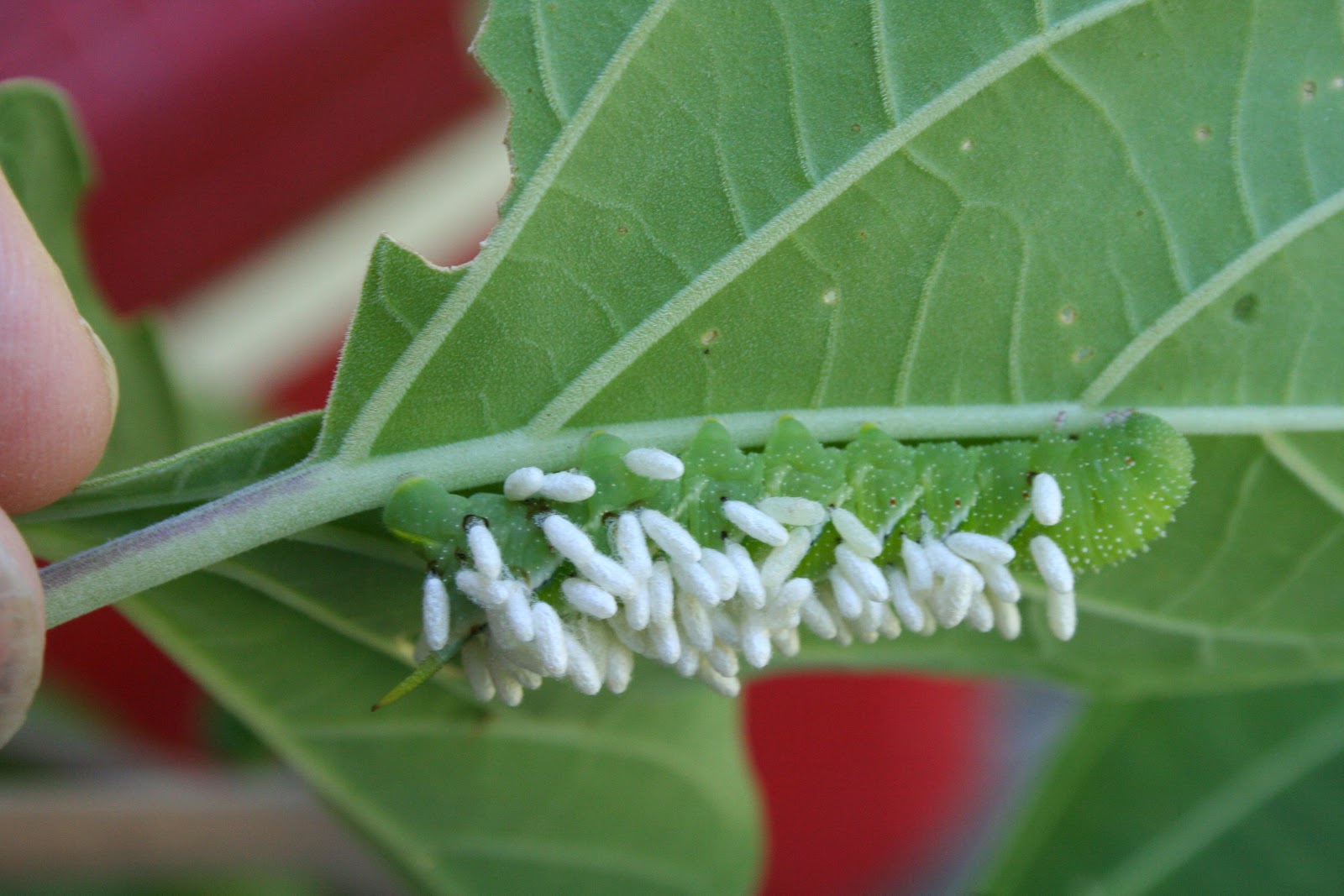
Gross but Great in the Garden

If you happen to see this sight in your garden, let it be. This is a tomato hornworm carrying the beneficial eggs of a braconid wasp. Normally I hate wasps but when these hatch there will plenty of the little freaks to guarantee that your garden is hornworm-free (although I'd still check your tomato plants regularly––just one of these little green buggers can chomp at a rapid pace!). In the meantime, the worm is paralyzed by the emergent eggs and can't do any more chomping on your precious tomato plants. (They can also affect tomato plants, too.)


The other day I was watering the tomato seedlings that my friend Diana had given me (and she still has some plants available at Meadowbrook Orchards and Farm). I noticed the tell-tale signs of the dreaded hornworm: lots of poops, chomped leaves, and then, the nasty creatures themselves (who are hard-pressed to be found, given their excellent camouflage). Overnight they had taken out half the leaves on half the plants!


Then, this morning, my sons noticed that our two datura plants (called 'Moonflowers' here by many native Kentuckians: I got these at Hettmansperger Greenhouse) had four worms that were covered with white eggs. Thankfully, they asked me first before squishing them (or throwing them at each other, which is more apt).

The worms were on the underleaf side of the two datura plants (which must be an attractant, like the tomato plants). I decided to clip the leaves and put each one in the shade of some of my potted tomato plants across the way. We'll see what happens. If I find any more without wasps on them they will be plucked off and fed to my free-range chickens.

The datura plant (at left), also called 'Moon Flower,' has a lovely trumpet-like
bell flower that emerges in early evening. My plants were started by seed saved
by some Casey County women and passed along to Hettmansperger Greenhouse.
WARNING: it is highly toxic to people and pets. But the hornworms must like it!

It just goes to show you that, if left alone, nature often takes care of things quite nicely.

Wednesday, January 25, 2012

Housekeeping – or is that Farm-keeping?

We are currently gathering information and updating all events, and the Casey County Produce Auction schedule, for 2012. Plans are also in the works for an initial get-together in late February of all interested Casey County farmers and others for fellowship, possible regular programs and perhaps to organize a 'Farm Day' open house in Casey County for sometime this year. Let us know if you'd like to be on the mailing list. Details to follow!

In the meantime, check (and join!) our 'GROW Casey County' Facebook page for more regular updates (which are also always visible in the right sidebar if you're not on Facebook). Feel free to email us at info@CatherinePond.com if you need specific information sooner.

Monday, November 14, 2011

Have a Blessed Holiday Season!


We wish you all the joys of the holiday season
and the bounty that life offers you.


We are taking a bit of a break here for the holidays and will be posting any upcoming items of interest on our Facebook page: so make sure to friend us at "Grow Casey County" [our 150th and 200th Friends will also receive bountiful gift baskets of Casey County products, if before or during the holidays!]

We will certainly return in the New Year, if not before, with more on Casey County's agricultural and local offerings and stories of interest.

In the meantime if you need to reach us, please email at info@CatherinePond.com

Many thanks to you all for your support in our first year!


Thursday, September 22, 2011

September Song


Tomorrow is the first official day of autumn and it seems to have arrived here in south-central Kentucky with all of its delights and offerings. This following was shared by Joberta Wells, a regular columnist for The Casey County News and a regular 'hoot.' She returned to Casey County in 1994 after being away for over three decades. It's a great place to come back to, or to move to, that's for certain. Joberta writes:

'Years ago every little community in Casey County, Kentucky had a correspondent for The Casey County News. They collected tidbits of happenings from their areas and submitted these news items. You knew who got married, who had a baby, who died, who went to Lexington to see a specialist (a doctor with more training and education than the local general practitioner), whose cow broke through the fence into a neighbor's corn field, etc.


The correspondents for Yosemite, KY were sisters named **Wauda Coffey and Jesse Anderson. These ladies engaged in rather florid prose but occasionally they got it just right. In the September 22, 1949 edition of The Casey County News they reported the following':
   
The countryside is taking on the richness of autumn. Almost all the tobacco is in the barns where one sees the long leaves turning to pale gold. September has been perfect for curing the crop and for making the fall hay. Mowing machines are busy and fields are dotted with green bales, or bordered with stacks, and barns are being filled. Cornfields are brown and look a month later than the calendar says. Nature's flower garden is bright with goldenrod, purple ironweed, and many other blossoms. Buds of the summer farewell are opening instead of waiting for October to call them on the stage. It's a lovely time to be living.'


**Yes, she really was a woman named 'Wauda' –– I had changed it to Wanda, thinking it a type-o and Joberta nicely reminded me not to do that!


Saturday, August 20, 2011

Lady Liberty

I saw a reference to this poster today on someone's Facebook page –– it just seemed relevant to Casey County (and I have an interest in World War II-era Victory Garden propaganda). The City of Liberty, of course, is at the center of county government and most commerce and yet not its agriculture or tourism. And liberty as a value is central to all we value in the United States of America: freedom, self-determination, free will. It is at the core of our democracy and our human rights and our right to worship as we please. It is our right to bear seeds! [OK, so I was just getting a bit too, well, soap-boxy there for a moment.]

Everything that goes around seems to come around again in society. Here we are in harsh economic times where we will likely have to become even more sustainable to feed ourselves, just as in the Great Depression of the 1930s and during World War II when Victory Gardens were part of the war effort at home. Now, more than ever, with debt ceilings and world economic collapse––not to mention the high price of gas––we need to look more local to where we shop, what we eat, and what we grow. As my grandmother, a midlife farmwife herself, used to say: 'The pendulum is swinging back again.'

Kentucky's own Wendell Berry wrote: A community economy is not an economy in which well-placed persons can make a 'killing'. It is an economy whose aim is generosity and a well-distributed and safeguarded abundance. An advocate of family, family farms, and the importance of community, he has outlined seventeen tenets for successful rural communities. Here are some of them (you can read them all here):

  • Always ask of any proposed change or innovation: What will this do to our community? How will this affect our common wealth?
  • Always include local nature - the land, the water, the air, the native creatures - within the membership of the community.
  • Always ask how local needs might be supplied from local sources, including the mutual help of neighbors.
  • Always supply local needs first (and only then think of exporting products - first to nearby cities, then to others).
  • Develop small-scale industries and businesses to support the local farm and/or forest economy.
  • Strive to supply as much of the community's own energy as possible.
  • Make sure that money paid into the local economy circulates within the community and decrease expenditures outside the community.
  • Make the community able to invest in itself by maintaining its properties, keeping itself clean (without dirtying some other place), caring for its old people, and teaching its children.
  • Always be aware of the economic value of neighbourly acts. In our time, the costs of living are greatly increased by the loss of neighbourhood, which leaves people to face their calamities alone.
  • A rural community should always be acquainted and interconnected with community-minded people in nearby towns and cities.
  • A sustainable rural economy will depend on urban consumers loyal to local products. Therefore, we are talking about an economy that will always be more cooperative than competitive.

Reading the agrarian writings and poetry of Wendell Berry always cheers me, but here's the silver lining to all of the doom and gloom out there: ask yourself what you and your family can do locally in your own community to make a difference to your local economy. What can you buy or what business can you patronize where you don't have to travel more than 10-15 miles, or out of county, to do it? We all need to go further afield when necessary, or just to get out of Dodge, but so much is in our own backyards or right down a pleasant county road.

So give me Liberty and give me 'maters! [With apologies to Patrick Henry.] In Casey County it is quite possible to have both.

Saturday, July 30, 2011

Farm Attic: Part 2 on Chicken Farming

Cover art is often a selling point of older magazines
but I also like farm-related magazines for their content.
Yesterday I received a magazine I had ordered––mainly for the cover, but also for the content. The Farmer's Wife eventually merged with The Farm Journal but for several decades it was its own magazine. It was specifically 'A Magazine for Farm Women' with fictional stories, recipes, columns and useful advice for home and farm. You can still find these magazines, on occasion, in good condition (eBay, for one) and I got this one for less than I'd pay for a new magazine. I want to frame the cover, above, and keep the contents (or frame the magazine and photocopy inside first).

So in browsing the contents I was pleased and delighted to find––especially after yesterday's first installment of 'Farm Attic,' with the photo of Mammy Wells with her chickens, c. 1924––a column in this July 1926 issue of The Farmer's Wife called 'The Farm Woman's Poultry Business.' Here is an excerpt:
Who is interested in raising or breeding poultry? First the farmer's wife, for she knows the value of the fresh egg, the spring fry, the Thanksgiving turkey, the Christmas goose. Her family must be supplied with the very best. Next comes the housewife with the backyard flock. Then the teacher, the banker, the preacher, the club boys and girls, and lastly the men and women who make their entire living from the rightly named 'commercial flock'––they keep no birds that can not pay their way. Sentiment is eliminated... Some day we may have an over-production but when that time comes if each individual in the United States eats three and one-half chickens a year, the entire supply will be wiped out.

Of all agricultural products in the United States, in 1923 only four (dairy products, corn, cotton and hogs) were of greater value than poultry [which is listed as a value of $1,050,000,000 dollars in 1926!]...We have never known the time when there wasn't some sort of poultry in the barnyard or the back yard and because it is so common most of us have taken it for granted and do not know its history or its economic value.

~ From the column, 'The Farm Woman's Poultry Business,' conducted by Clara M. Sutter, The Farmer's Wife, July 1926, pp. 366-367.  
Written on the back of this photo: 'Brooder house and Grandma Bannie's
chickens across the drive near the corner of road.' c. 1940

Here is a related photo from the history of our own farm. We're just over the Casey County line in Pulaski County, a mile or so as the crow flies from Mintonville, and we can see Green River Knob from our own knob (so we can at least see Casey County). The house on the left still exists and was updated in the 1990s by the former owner. It is now our farm cottage. And, among other things, we keep chickens, too.

Friday, July 29, 2011

Farm Attic: Mammy and Her Chickens


This photo shows Elizabeth (Lizzie) Sweeney Wells, c. 1924, with her flock of chickens. Lizzie was the grandmother of Joberta Wells, who submitted this photograph. Joberta lives on her grandmother's farm, just outside of Yosemite, and in recent years recreated the classic three-gabled farmhouse from the foundation up.

Farm women were often photographed with their chickens and it is one of the most common scenes depicted in old farm photographs. Women tended the flocks on small amounts of land around the farmhouse or yard and gathered the eggs. Their 'egg money' was a valuable asset to farm income and their flock would have been a source of personal pride. Tending chickens was also an area where younger children could assist, including feeding and egg-gathering.

In an excellent paper on The Contemporary Farm Woman: 1860 to the Present, published by the Central New York Resource Conservation and Development, Inc. [Isn't the Internet amazing?] Stephanie Fisher writes:
"Women could exercise complete control over the production and income of their chickens. However, women often chose to spend the money to assist the farm or farm home. During hard economic times, the egg money, known as ‘pin-money,’ often saved the farm when their husband’s commodities failed to provide income...Women’s participation in chicken farming and the production of eggs continued until around the 1940s."
[World War II changed society and farming practices, after which factory-farming became more prevalent. However, in many rural areas, such as Casey County and throughout much of Kentucky, sustenance farming continued, much as it does today with household gardens, chickens and other livestock to support the family.]
Do you have a farm story or photographs to share in our 'Farm Attic'? We'd love to see them here and if you'd like to write something about Casey County farm history, stories or traditions, we are happy to publish it.

NOTE: For two excellent first-hand period accounts of life with chickens, read Betty MacDonald's classic The Egg and I, written in 1945 and made into a movie (that launched the popular Ma and Pa Kettle films) or Mildred Armstrong's recent best-selling account of Midwestern farm life in the 1930s, Little Heathens–Hard Times and High Spirits on an Iowa Farm During the Great Depression

Thanks to Joberta Wells for her contribution to this entry.

Sunday, June 12, 2011

This Blog is Your Blog

Old postcard of a family eating watermelon––one of Casey County's greatest exports!

Yes, I'm kind of singing along to Woody Guthrie today in my head: "This land is your land, this land is our land..." I don't even live in Casey County (but I can see Green River Knob rising near us to the west from our knob over here in the western edge of Pulaski County––and we are only an air mile or so, not counting winding country roads, from Mintonville, in the southeast corner of Casey County). But I appreciate all of the fine agricultural offerings and the beautiful rural quality of Casey County. We would have likely bought a farm in the county when we were looking, but this part of the world––not very far away––presented the right place at the right time. Yes, we are transplants but are putting down new roots in your wonderful state.

We do much of our business in Liberty and just as much out in the Old Order Mennonite community in South Fork Creek. We buy our various feeds and bedding, and other supplies from Goldenrod Feeds, our staple food items from Sunny Valley Bulk Foods, and much of our produce and garden plants at Hillside Greenhouse, Homestead Gardens, South Fork Produce, Lavern's and often at the Casey County Produce Auction. There are many other businesses, too, sprinkled about the region that get our business. That is what buying and being (and eating) local is all about.

This blog was started to promote the Old Order Mennonite agricultural-related businesses––who also form the very basis of Casey County tourism––which do not have an internet presence (and neither do they join commerce groups). I soon realized, where do people go, on-line, to find out more about Casey County's great local farms and other offerings, especially throughout the season as things are offered or events held?

Yet this blog is also about the wider produce and agricultural offerings of Casey County that include anyone who grows, raises or sells farm products––or promotes them. It is a work in progress (I still have to post names/addresses of related agricultural businesses, among other things, in the tabs above) and is a volunteer effort. But I can promise that it is your blog, too. Feel free to drop me an email at info@CatherinePond.com or leave a comment at any time on this blog as to what you might like to see here over the coming months. I will probably focus more on local farm history and interesting items, or articles, in the "off season," when there are few things available from farms or fields, and more on produce and availability––and events––during the summer and fall months. And don't forget to join the "GROW Casey County" Facebook page for more regular updates and tidbits.

Thanks for reading and please tell your friends to check here, too! In the coming days there will be more promotional rack cards available for pick-up throughout the county.

Sunday, May 29, 2011

Grow Casey County Cards!


Postcard size promotional cards are available at certain area vendors in Casey County for customers and tourists to pick up and will be mailed to a wide mailing list across the state in the coming week.

GROW Casey County will continually provide updates throughout the year on what's in season when and also where to find it in Casey County. It is also the place on the Internet to find out about Old Order Mennnonite and Amish businesses in the region, as well as other agriculture-related offerings and businesses that likely don't have a web presence. And, it will be a resource for regional events and auctions related to the farm community here in Casey County.

If you want some cards for your business, or know someone who should be on the list, just let us know: info@CatherinePond.com

Help spread the good word about Casey County produce offerings!